
Shipton's Camp (4,200 m): Everything You Need to Know Before You Arrive
Shipton's Camp is where most Sirimon trekkers spend two nights. Here is what the camp looks like, how to sleep at 4,200 m, and why the acclimatisation day is not optional.
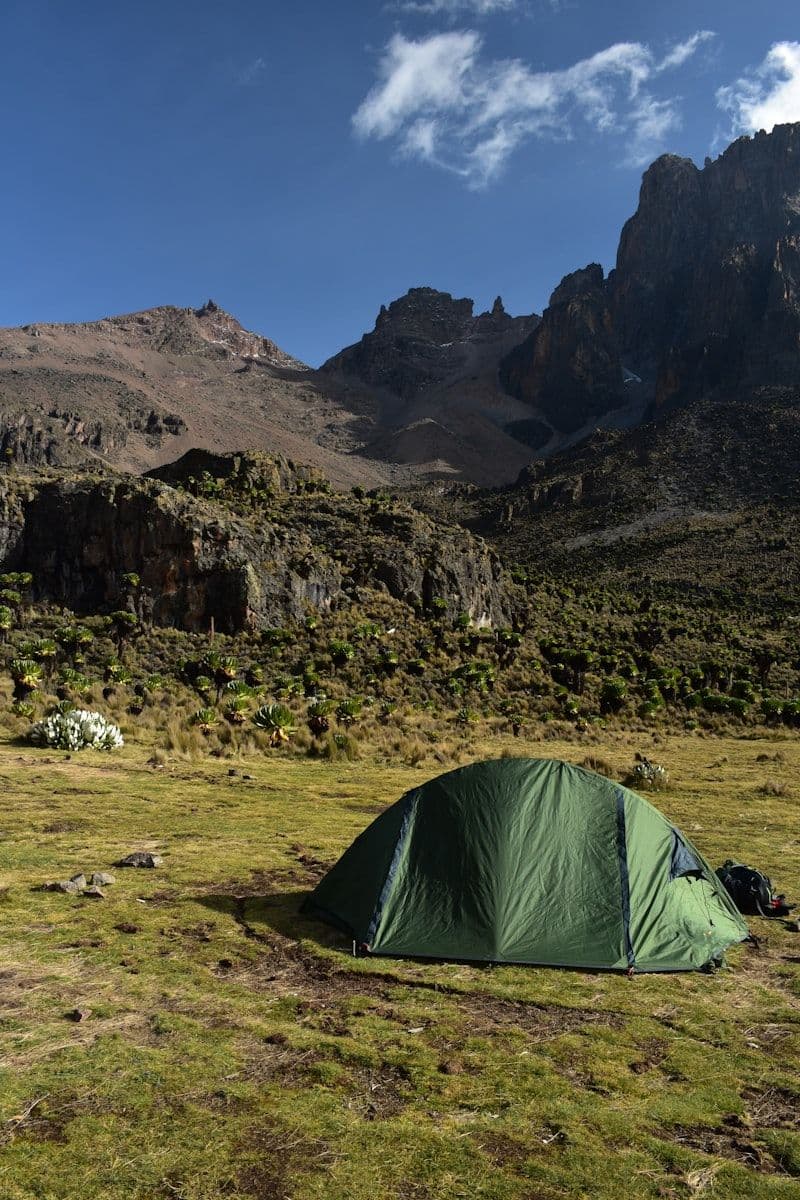
Shipton's Camp sits at 4,200 m on the northern flank of Mount Kenya, directly below the rock walls of Nelion and Batian. It is the highest sleeping point on the Sirimon route, the base for the acclimatisation day, and the launch point for the pre-dawn summit push. Most Sirimon trekkers spend two nights here.
If there is one place on this mountain where preparation and expectations matter most, it is Shipton's Camp.
The Camp Itself
Shipton's Camp is a Kenya Wildlife Service campsite with basic bunkhouse accommodation and camping space for tents. Toilet facilities are basic pit latrines. There is no running water; streams nearby provide water that needs treating or boiling before use.
Our groups camp in tents rather than the bunkhouse, which gives more flexibility on timing and significantly better sleep quality. Your guide and cook are camped alongside you throughout the stay.
Sleeping at 4,200 m
The most common experience on the first night at Shipton's is poor sleep. This is normal and expected. Altitude disrupts sleep architecture. You may wake frequently, have vivid dreams, and feel less rested than you did at lower altitude.
This is not a medical emergency. It does not mean you will not summit. It means your body is doing exactly what bodies do at altitude: adjusting. The second night at Shipton's, after the acclimatisation day, is almost always better than the first.
Practical tips: sleep with an extra layer on. Drink water before you sleep and keep a bottle inside your sleeping bag so it does not freeze. A mild headache on arrival is expected. A worsening headache that does not respond to ibuprofen or paracetamol is a reason to tell your guide immediately.
The Acclimatisation Day
The 5-day Sirimon itinerary includes an acclimatisation day at Shipton's. This day involves no upward movement beyond a hike to around 4,600 m, followed by a return to sleep at 4,200 m. This day is not optional and is not downtime.
The principle is climb high, sleep low: briefly stressing the body at a higher altitude, then letting it recover at the sleeping altitude. It works. Groups that take the acclimatisation day seriously have materially better summit-day outcomes than those on compressed itineraries.
A typical acclimatisation day might involve a morning walk to Kami Hut (4,450 m) or the false summit of Lenana at around 4,600 m, a few hours of rest in the afternoon, an early dinner, and bed before 21:00. The goal is rest and hydration, not exploration.
The Evening Before Summit Day
Dinner on the evening before summit day is important. Eat more than you want to. The altitude suppresses appetite but the caloric demand of a nine-hour summit day is real. Our cook prepares a carbohydrate-heavy meal such as pasta, rice, or ugali, and this is the one meal we actively encourage clients to finish.
Lay out every item you will need for the summit before you sleep. Headtorch with fresh batteries. Warm layers in the order you will put them on. Your guide will do a kit check before departure, but the morning is not the time to be searching for your down jacket.
Set your alarm for 03:00. Inform your guide or tent-mate of your start time. Then try to sleep.
After the Summit
You will return to Shipton's from the summit sometime between 09:00 and 11:00. Eat something. Rest for an hour. Then begin the descent to Old Moses Camp (3,300 m), which takes three to four hours.
The altitude drop from 4,200 m to 3,300 m is significant. Most clients describe it as the moment the trek finally stops being hard. The air is thicker. The head clears. You will be hungry in a way you have not been since day one.